

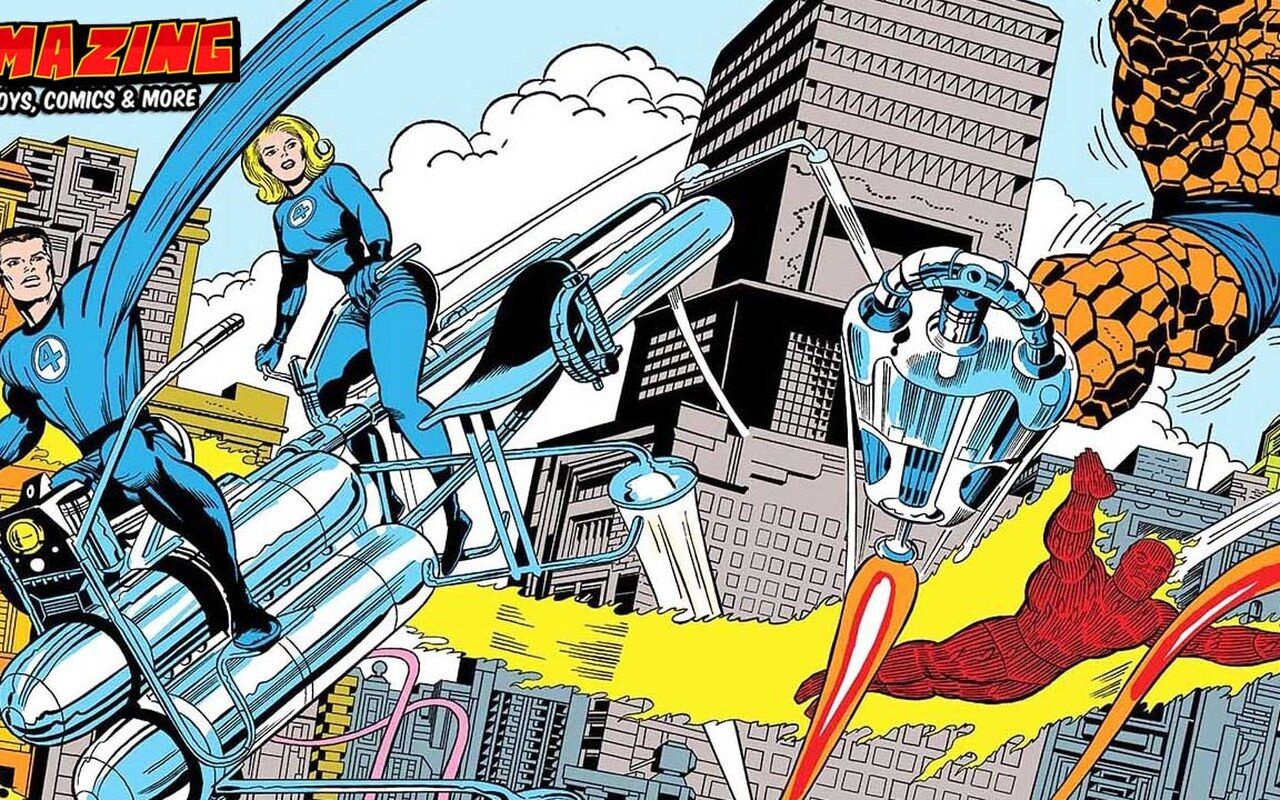
Fantastic Four
 Thomas Sr. (Captain Collector)Last updated: 21 June 2019 approx. 3 min read
For die-hard Marvel comic fans, the Silver Age par excellence began in 1961 with the Fantastic Four. Well, actually 1956 is regarded as the official start. That was when, in the DC comic Showcase #4, the new Flash appeared for the first time. But in the end, they're just years, reference points. For Marvel enthusiasts it's simply easier to remember issue 1 of Fantastic Four.
Jack Kirby and Stan Lee modernised Marvel Comics back then by departing from the tried-and-tested formula of the monster books and trying their hand at superheroes. The competition at DC clearly showed that there was money to be made with this genre, and that's what it was ultimately about. Comics had to sell; they had to prove as profitable as possible on the newsstands.
The 4
The concept was relatively simple. A few years earlier at DC, Jack Kirby had already created the Challengers of the Unknown, four adventurers with different abilities and strengths who faced all kinds of dangers. Now all he and Stan Lee had to do was dream up the four new characters, breathe superhero powers into them and tell an origin story. That's all! Or is it?
After a failed trip into space and a hefty dose of cosmic rays, the four find themselves with strange abilities. Reed Richards is the super-intelligent egghead of the group and can stretch his body like rubber. He is Mr. Fantastic. Johnny Storm bursts into flame without burning up and becomes the Human Torch. His sister Sue can make herself invisible and from then on is Invisible Girl. And finally there's the gruff, grim old grouch Ben Grimm, who turns into a super-strong something. He is the orange mosaic rock monster Thing.
Dream team Kirby/Sinnott
The secret of the huge success of Marvel's First Family, as the four are affectionately known, lies in the mix of heroes and in the fact that they are real people with real problems, not just two-dimensional paper superheroes. On top of that comes the series' fantastic, inimitable art style, shaped in the mid-1960s by Jack Kirby and inker Joe Sinnott.
This stylistic continuity lasted for years and only ended with Jack Kirby's departure from Marvel in 1970. Kirby sent his pencils to Sinnott, who inked them and passed them on to the Marvel editorial office. The two only met in person years later, in 1975.
Incidentally, one of the most dazzling (literally!) characters in the Marvel Universe first saw the light of day in 1966 in the pages of the Fantastic Four comics (in issue 48): the Silver Surfer. Together with the eternally hungry world-devourer Galactus, the Surfer is Jack Kirby's own creation. He was later polished up and reshaped in character by the busy Stan Lee so that he would fit better into the Marvel Universe. Great as a comic, the four are still patiently waiting for a film adaptation that finally does them justice.
Did you know that in the first clash between the Fantastic Four and the almost all-powerful Galactus, the world-destroyer was finally put out of action with a mini weapon no bigger than a toy pistol? It was the Ultimate Nullifier!
Thomas Sr. (Captain Collector)Captain Collector's Subtle Superhero TriviaFantastic Four at AMAZINGTOYS®
You'll find comics from every decade under Fantastic Four.

Clarity. Strategy. Building wealth.With Ready for Money, Thomas B. Kovacs shows you step by step the concrete path to your first 100 000 Swiss francs – and far beyond. Clear, practical and uncompromisingly geared to Swiss reality.Whether you're just starting out or already investing – this book gives you the foundation for real financial freedom.💡 What awaits you: Concrete, immediately actionable steps for systematic wealth building The trinity of success: Earn. Save. Invest. Smart diversification for stability in times of crisis Practical knowledge specifically for the Swiss financial system Sustainable strategies for long-term self-determination One tool. One plan. One investment in yourself. 🚀 Don't wait for the perfect moment – start your financial future now and secure your personal copy!More about the author Thomas B. Kovacs.

With a digital gift card, you've made exactly the right choice – the person you're giving it to can fulfil their own wishes right away. Can't find the right gift? Before you buy something they might never use, let the recipient decide for themselves. During its validity period, the voucher can be used without restriction on amazingtoys.ch or in the AMAZINGTOYS® Store. It cannot be replaced if lost or stolen. The validity period is 5 years from the date of payment. No cash payout is possible.Important note: The digital voucher is sent by email immediately after payment is completed. Please note that the voucher code can only be used once payment has been received.
With a digital gift card, you've made exactly the right choice – the person you're giving it to can fulfil their own wishes right away. Can't find the right gift? Before you buy something they might never use, let the recipient decide for themselves. During its validity period, the voucher can be used without restriction on amazingtoys.ch or in the AMAZINGTOYS® Store. It cannot be replaced if lost or stolen. The validity period is 5 years from the date of payment. No cash payout is possible.Important note: The digital voucher is sent by email immediately after payment is completed. Please note that the voucher code can only be used once payment has been received.
With a digital gift card, you've made exactly the right choice – the person you're giving it to can fulfil their own wishes right away. Can't find the right gift? Before you buy something they might never use, let the recipient decide for themselves. During its validity period, the voucher can be used without restriction on amazingtoys.ch or in the AMAZINGTOYS® Store. It cannot be replaced if lost or stolen. The validity period is 5 years from the date of payment. No cash payout is possible.Important note: The digital voucher is sent by email immediately after payment is completed. Please note that the voucher code can only be used once payment has been received.
With a digital gift card, you've made exactly the right choice – the person you're giving it to can fulfil their own wishes right away. Can't find the right gift? Before you buy something they might never use, let the recipient decide for themselves. During its validity period, the voucher can be used without restriction on amazingtoys.ch or in the AMAZINGTOYS® Store. It cannot be replaced if lost or stolen. The validity period is 5 years from the date of payment. No cash payout is possible.Important note: The digital voucher is sent by email immediately after payment is completed. Please note that the voucher code can only be used once payment has been received.
With a digital gift card, you've made exactly the right choice – the person you're giving it to can fulfil their own wishes right away. Can't find the right gift? Before you buy something they might never use, let the recipient decide for themselves. During its validity period, the voucher can be used without restriction on amazingtoys.ch or in the AMAZINGTOYS® Store. It cannot be replaced if lost or stolen. The validity period is 5 years from the date of payment. No cash payout is possible.Important note: The digital voucher is sent by email immediately after payment is completed. Please note that the voucher code can only be used once payment has been received.

ONE PIECE Saikyo Jump Promo Pack“Summit Powerhouses Pack”3 cards per packEdward Newgate {P-152}Portgas D. Ace {P-153}Monkey D. Luffy {P-154}All cards feature metallic foil treatment!

Ultimate Guard Comic Bags Resealable - Silver Size (100) Ultimate Guard comic accessories 100 premium, resealable protective sleeves for comics up to 181 x 268 mm (7 1/8 x 10 1/2 inches) in size. Maximum transparency 5 cm wide, resealable closure flap PVC-free, acid-free Archival safeImportant note: Due to the production process, slight warping of the product cannot always be avoided. A deviation of 3mm is within the tolerance range and therefore does not constitute a defect. Any warping that occurs can be corrected by carefully bending the card stock in the opposite direction.

Ultimate Guard Silver Size Comic Bag + Backing Board Bundle High-quality Silver Size comic bag + backing board for safely archiving comics. Ideally suited for long-term storage Package Contents: 1x Ultimate Guard resealable comic bag, Silver Size 1x Ultimate Guard comic backing board, Silver Size The comic is not included. Product Size: 26.8 x 18.1 cm (H x W cm)

Avengers #8 Facsimile Comic: Avengers #8 Language: English Publisher: Marvel Comics Year: April 2023 Condition: Near Mint, NM, 9.4 Avengers #8 as a facsimile edition of the original issue 8 with the first appearance of Kang the Conqueror. A classic of the Silver Age of Marvel Comics reissued! The issue is in near-mint condition. Tags: avengers, kang, kang the conqueror, jack kirby, stan lee, marvel comics

Savage She-Hulk #1 Facsimile Comic: Savage She-Hulk #1 Language: English Publisher: Marvel Comics Year: February 2023 Condition: Near Mint Plus, NM+, 9.6 Savage She-Hulk #1 as a facsimile edition of the original issue 1. A classic of Marvel Comics' Bronze Age, reprinted! The issue is in like-new condition. Tags: she-hulk, savage she-hulk, marvel comics

100 high-quality and resealable protective sleeves for manga with a size up to 15 x 21.8 cm.– Suitable for most manga and graphic novels– Extremely high transparency– Resealable closure flap– PVC-free, acid-free– Archival safe