

Nintendo Entertainment System (NES)
424 products
You are now a member of the Silent Service, the US Navy submarine command. For a long time after Pearl Harbour, you are the only forces capable of striking back against the Japanese in the Pacific. Take command of one of the "Fleet Boats" and embark on extended patrols of up to 2 months from Hawaii, Australia or New Zealand. Set the difficulty level/realism level and time period (early means less technology for juicier targets, later means harder escorts, more technology, tougher targets). Consider factors such as duds, maximum depth and more. You have the choice between training runs against a couple of old hulks, recreating historical convoy attacks, a single patrol or your own campaign where you can conduct multiple patrols until you die, get promoted or survive the war. How will you stack up against history?
![Zdey The Game [Limited Edition] - NES](https://amazingtoys.cstatic.io/media/66/7a/48/1720705835/NES_000419_2593646_Modul.jpg?ts=1720709739 "Zdey The Game [Limited Edition] - NES")
Yoshi's Cookie is a fast-paced puzzle game. The player shifts randomly placed cookies in rows and columns of cookies with similar patterns. When a row or column of matching cookies is successfully assembled, the row disappears and the player can start with a new row or column. The "Yoshi" cookie is something special in both the 1-player and 2-player games. Since this cookie is the key to both games, it should be used wisely. The SNES version features an additional puzzle mode where players must clear the game board in a limited number of moves. This mode contains 100 unique puzzles.
![PERKELE - Suomi 100 Vuotta [Homebrew] - NES](https://amazingtoys.cstatic.io/media/47/56/0d/1720705743/NES_000255_4400428_Modul.jpg?ts=1720709646 "PERKELE - Suomi 100 Vuotta [Homebrew] - NES")
This is mainly a parody of Gradius (Nemesis on some systems), with some borrowings from other shoot-em-ups such as Twinbee. The series is available on numerous platforms. The game is a right-to-left scrolling shoot-em-up. You can choose from 4 different flying creatures with different weapons. You must complete 7 levels, each ending with a boss. You can start at one of two levels, but must complete each level to reach the final level.
![Juhannusolumppialaiset 2017 [Homebrew] - NES](https://amazingtoys.cstatic.io/media/3c/5c/c7/1720705694/NES_000168_4400429_Modul.jpg?ts=1720709596 "Juhannusolumppialaiset 2017 [Homebrew] - NES")
It is the year 0373 in the new Space Age calendar. Earth's population is growing rapidly and humans are now forced to establish space colonies. Jay McCray is one of those who leaves Earth and sets out for a colony in the Silius solar system. Unfortunately, terrorists have destroyed a research colony there. Jay's father was killed in this attack and Jay now swears to destroy the responsible terrorists and continue the research his father was working on. Journey To Silius is a side-scrolling platformer. In each level there are a variety of robot enemies guarding the terrorist fortress, as well as several weapons to be found, which make the mission easier. There are a total of six stages, each ending with a very large boss enemy.
Gremlin had a happy hand with this licensed Formula 1 simulation, as Nigel's long quest for a championship had finally been fulfilled. The game was somewhere between a full simulation like F1 GP and action games like Continental Circus. Only 12 cars competed in each race, which could last between 3 and 20 laps. Before each race you can adjust the downforce of the wing, the gear ratio, the tyre choice and the fuel load - pit stops are standard for longer races. The 16-bit versions include a unique "Improve With Mansell" mode, in which a digitised version of Nigel's head appears in the upper corner of the screen, issuing instructions and praise.
Gremlin had a happy hand with this licensed Formula 1 simulation, as Nigel's long quest for a championship had finally been fulfilled. The game was somewhere between a full simulation like F1 GP and action games like Continental Circus. Only 12 cars competed in each race, which could last between 3 and 20 laps. Before each race you can adjust the downforce of the wing, the gear ratio, the tyre choice and the fuel load - pit stops are standard for longer races. The 16-bit versions include a unique "Improve With Mansell" mode, in which a digitised version of Nigel's head appears in the upper corner of the screen, issuing instructions and praise.
![Juhannussauna 2016 [Homebrew] - NES](https://amazingtoys.cstatic.io/media/28/52/17/1720705694/NES_000169_4400430_Modul.jpg?ts=1720709597 "Juhannussauna 2016 [Homebrew] - NES")
It is the year 0373 in the new Space Age calendar. Earth's population is growing rapidly and humans are now forced to establish space colonies. Jay McCray is one of those who leaves Earth and sets out for a colony in the Silius solar system. Unfortunately, terrorists have destroyed a research colony there. Jay's father was killed in this attack and Jay now swears to destroy the responsible terrorists and continue the research his father was working on. Journey To Silius is a side-scrolling platformer. In each level there are a variety of robot enemies guarding the terrorist fortress, as well as several weapons to be found, which make the mission easier. There are a total of six stages, each ending with a very large boss enemy.
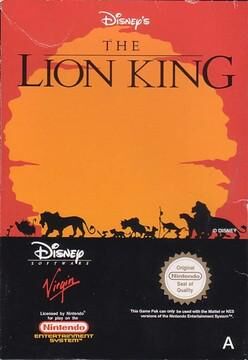
Disney's 1994 film The Lion King received a unique adaptation for Nintendo 8-bit systems. Although based on the 16-bit version, only a few levels from that game are directly adopted, while others are completely new or based only on the general concept. The player controls young lion Simba through nine levels (the NES version contains only the first six), most of which are side-scrolling platform affairs. At the start of the game, when Simba is still a young lion, he can jump and roar. Roaring stuns some enemies, jumping on them defeats them. Little Simba can also roll along the ground, allowing him to destroy some obstacles. From level seven onwards (not in the NES version), Simba has grown up and gains the ability to scratch enemies with his claws to defeat them, but loses the ability to roll. Enemies to destroy or avoid include lizards, porcupines (which must be stunned to be flipped over as you cannot jump on them), beetles and spiders. The hyena henchmen from the film also appear and are harder to destroy than most other enemies. The final boss in the game is, of course, Simba's uncle Scar. Power-ups that can be collected include beetle symbols that partially or fully restore health, one-ups and lion symbols that create a save point in the level. There are some deviations from standard platforming: the stampede scene from the film is recreated in a level where Simba is seen from above and automatically walks to the right. He must move up and down to avoid being trampled by water buffalo. Another level is shown in the standard platforming view but consists of a series of interconnected rooms where hyenas wait for Simba. He must defeat them before the entrance to the next room opens. Collecting a special beetle symbol found in some of the levels activates the "Beetle Patrol" mini-game. In this game, the player controls Pumbaa, who must catch beetles thrown down the screen from above while avoiding large spiders. If you catch enough beetles, life and continue symbols fall. Less
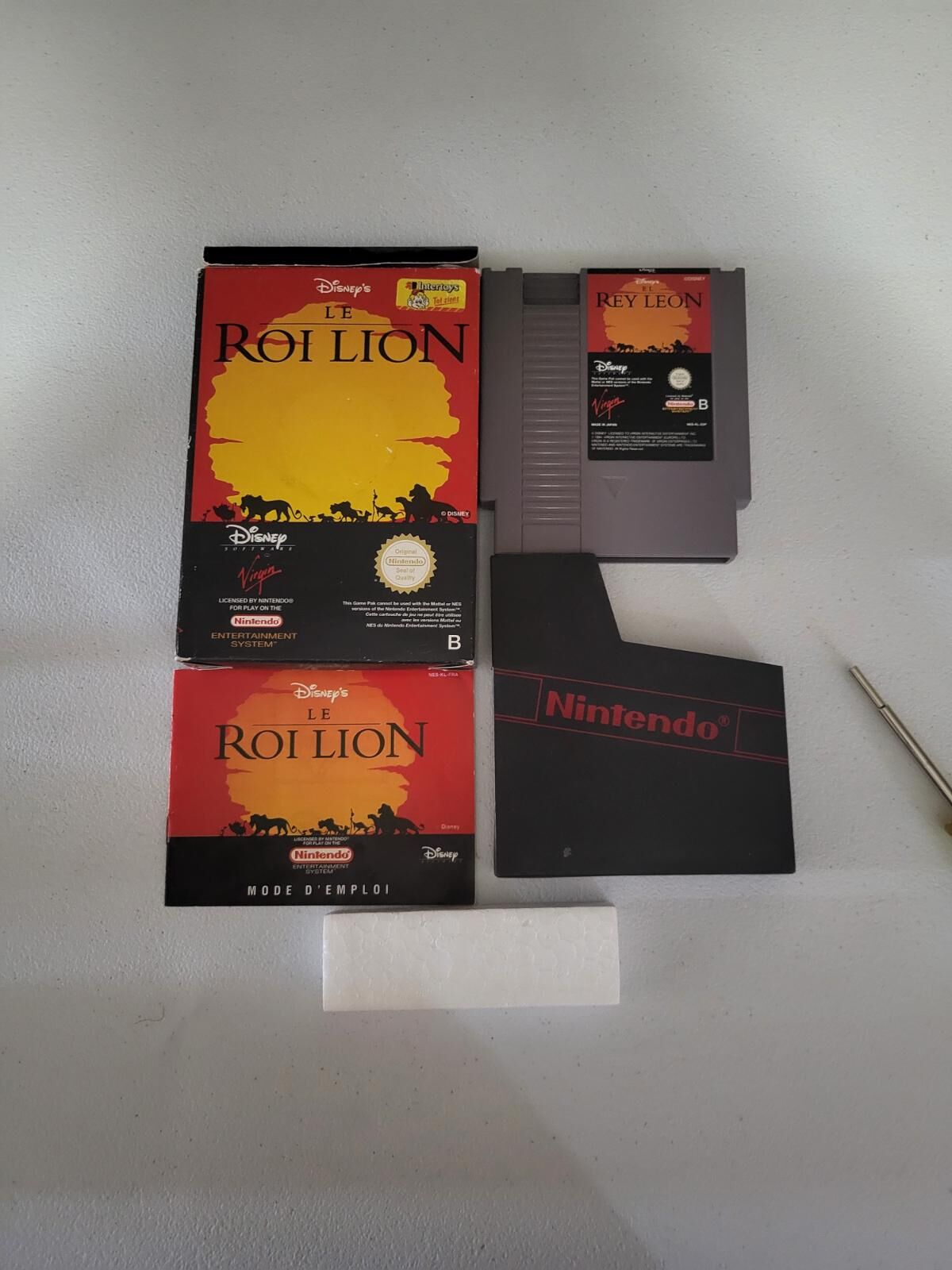
The Disney film The Lion King from 1994 received a unique adaptation for Nintendo 8-bit systems. Although it is based on the 16-bit version, only a few levels from that game are directly adopted, while others are completely new or based only on the general concept. The player controls the young lion Simba through nine levels (the NES version contains only the first six), most of which are side-scrolling platforming affairs. At the beginning of the game, when Simba is still a young lion, he can jump and roar. The roar stuns some enemies, jumping on them defeats them. Young Simba can also roll along the ground, allowing him to destroy some obstacles. From level seven onwards (thus not in the NES version), Simba has grown up and gains the ability to scratch enemies with his claws to defeat them, but loses the ability to roll. Enemies to destroy or avoid include lizards, porcupines (which must be stunned to flip them over, as you cannot jump on them), beetles and spiders. The hyena henchmen from the film also appear and are more difficult to destroy than most other enemies. The final boss in the game is of course Simba's uncle Scar. Power-ups that can be collected are beetle symbols that partially or completely restore health, one-ups and lion symbols that create a save point in the level. There are some deviations from standard platforming: The stampede scene from the film is recreated in a level where Simba is viewed from above and automatically walks to the right. He must be moved up and down to avoid being trampled by water buffalo. Another level is viewed in the standard platforming perspective, but consists of a series of interconnected rooms where hyenas wait for Simba. He must defeat them before the entrance to the next room opens. Collecting a special beetle symbol found in some of the levels activates the "Beetle Patrol" mini-game. In this game, the player controls Pumbaa, who must catch beetles thrown down onto the screen from above, while avoiding large spiders. If you catch enough beetles, life and continue symbols fall. Less
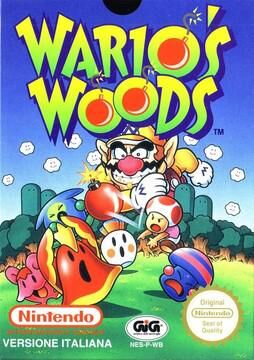
Wario's Woods is a puzzle game similar to Tetris or Columns, but with a twist. Instead of directly controlling the falling monsters and bombs, the player controls Toad, who must carry a stack of monsters and bombs and combine them correctly. A bomb and at least two monsters of the same colour must be combined to make them disappear. If five or more objects disappear simultaneously, a diamond appears. If you destroy the diamond, all monsters of the diamond's colour disappear. There are four different ways to collect objects. With the A button, Toad can lift the entire stack in front of him; with the B button, just one object, even if it's in the middle of the stack; with the Y button, he can kick a monster or bomb in front of him; and with the X button, he can climb onto the stack he's carrying. He can also run up walls and stacks to catch falling objects from the air or collect specific parts of a stack. There are 5 different game modes: a "Round Game" where Toad must clear numerous levels, a match against a computer-controlled opponent, a two-player mode, a "Time Attack" mode, and finally an extensive training mode. There are some differences between the SNES and NES versions. Due to missing buttons, the controls in the NES version are slightly different (although all moves from the SNES version are present). Additionally, there is no Computer mode, but the "Round Game" mode offers two play modes: one that includes boss fights in every level, ending with a 9.
The evil Gargamel has captured three of the Smurfs so he can eat them (once again) for dinner. One of the Smurfs must embark on a dangerous journey to rescue the captured Smurfs. Defeat the first two bosses to rescue the first two Smurfs, then you can face Gargamel. Make your way through forests, swamps, mountains, mines and more. Also ride on storks, mine carts and tree trunks to defeat Gargamel and his minions and rescue the missing Smurfs. In each level you must collect five stars to gain access to the bonus level (you don't need to collect the five stars to complete the main level). Try to collect as many bonuses as possible in the bonus level before time runs out. There are three bonus levels: "The Dam", "The Mushrooms" and "The Butterflies".
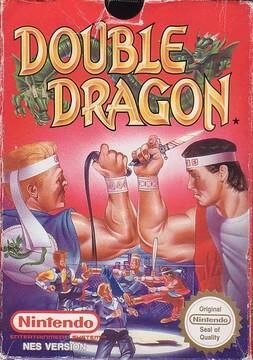
Earth is under fire from Colossus, a warship the size of a city. With mighty laser cannons, it has destroyed most of Earth's defence forces, whilst its numerous troops clean up the rest of the planet. Everything except 5 warriors. The Battletoads, well aware of evil powers in the galaxy, team up with Billy and Jimmy Lee from Double Dragon to defend Earth from the deadly ship and its forces. Using a series of special manoeuvres, you must fight your way through the streets to the heart of the ship and destroy it.
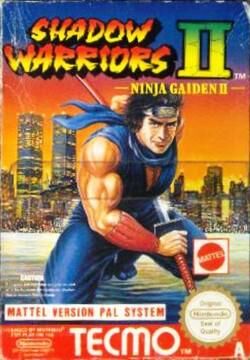
A year after the events of the original Ninja Gaiden, a new villain named Ashtar learns of Jaquio's defeat. Ashtar seizes the opportunity and devises a new plan to plunge the world into darkness. Ninja Ryu Hayabusa sets out to destroy all manner of hideous creatures invading the world as he makes his way to eliminate Ashtar, his dark sword of chaos, and whatever else lurks behind the evil. Ninja Gaiden II: The Dark Sword of Chaos is a fast-paced, side-scrolling action game in the tradition of the original Ninja Gaiden game. Ryu is a ninja who can run, jump, and slash with his ninja sword. He can also cling to vertical walls and climb up and down, an ability lacking in the predecessor. Throughout the levels, power-ups are hidden everywhere. These power-ups include fireballs and ninja stars as before; a unique new power-up is the ninja shadow. Ryu can collect up to 2 ninja shadows that follow him everywhere and use the same weapons Ryu wields. Ninja Gaiden II tells its story through the generous use of cutscenes interspersed between the action levels. Various levels offer a variety of environmental interactions; in one level, for example, Ryu finds himself on a high mountain where it quickly snows and the wind blows hard. The changing direction of the snowfall indicates how the wind is blowing, and Ryu must battle against the breeze. In a night level, much of the environment is dark and only sporadically illuminated by lightning.
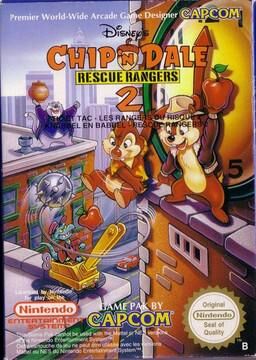
The Chessmaster is a game in which the player has the opportunity to play a standard chess game against the CPU-controlled Chessmaster. To play the game, the player must pick up chess pieces with the hand cursor and place them in the desired location, following the rules of a normal chess game. There are 16 different difficulty levels, including 2 beginner levels, 13 standard levels (averaging 5 seconds to 4.5 minutes per move depending on level) and an infinite level that thinks about a move until a perfect move is possible or the player is forced to make a move. There is also a learning mode that shows the player all possible moves with the selected piece. Two players can play against each other with two controllers, and there is also an option to let the Chessmaster play against itself.
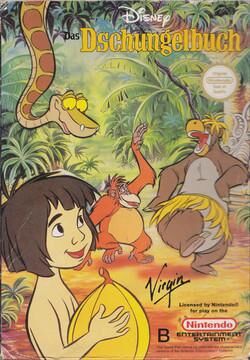
One of several games released in 1994 based on the Disney film The Jungle Book. The version for Nintendo's 8-bit console resembles the Genesis version in design but features a unique set of levels. In each of the 10 levels, the jungle boy Mowgli must collect a certain number of jewels to progress. Most are scattered throughout the level, but some are dropped by defeated enemies. Enemies consist of a variety of jungle animals such as snakes, monkeys, rhinoceroses and hedgehogs. Mowgli can jump on their heads or use a range of weapons to defeat them. These include bananas, double bananas, boomerangs and nuts. Ammunition for the three latter weapons must be collected from fallen enemies. Besides ammunition, Mowgli can also collect fruit to restore his health, a mask that grants him invincibility (which must be activated when needed), and a shovel that grants access to bonus levels. In every other level, the jewel hunt is followed by a boss battle. Here, not only the villains from the film appear, such as Kaa the snake, King Louie the monkey and Shere Khan the tiger, but for some reason Mowgli must also defeat his friend Baloo the bear.
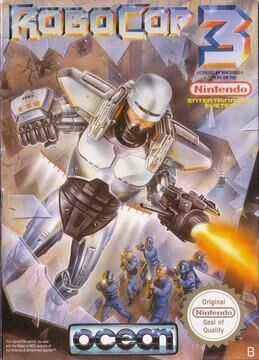
RoboCop 3 for the NES is a platform shooter game featuring the metal cyborg of the same name in the leading role. This version resembles in many respects the version for 8-bit computers, which was also developed by Probe Software: these games have the same level aesthetics, design, and music selection. However, the NES version is quite different: there is no first-person shooter level; instead, the first level is an exclusive side-scrolling level. All levels have a slightly altered design, and the boss enemies have also been redesigned, including the tank boss and the final boss battle, in which Robocop must do something entirely different than simply destroying the ninjas.
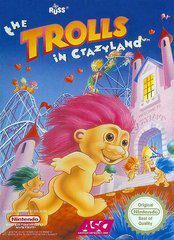
One day, an evil being kidnaps a girl at an amusement park. Her friend rushes to the rescue. The Trolls in Crazyland is a typical jump'n'run game featuring a boy who shoots at his opponents with a ball (in the Japanese original version). When the boy takes damage, his shirt colour changes and his weapon's power increases. From the remains of defeated enemies, he can collect a bird that allows him to chase and defeat enemies. For the European market, the main character's sprite was redrawn to represent a popular Troll character licensed from Russ Berrie & Co.
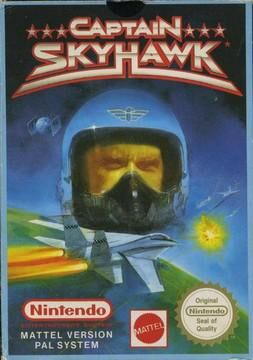
Extraterrestrials are draining Earth of its energy and plan to completely destroy it afterwards. Only Captain Skyhawk and his F-14VTS fighter jet can rid the world of these alien invaders. The game features eight missions divided into various phases. One phase is a vertically scrolling shoot-'em-up, with the action depicted from a top-down perspective in a 3D landscape. In this phase, the player must destroy enemy installations and bases. Another phase resembles the gameplay of After Burner, where the player must take out enemy aircraft. In another phase, the player must carefully dock their aircraft to a space station. In these space stations, the aircraft's weapons can be upgraded or refilled by spending credits earned by defeating enemy aircraft. After the player successfully completes all missions, they must destroy the final alien space station.
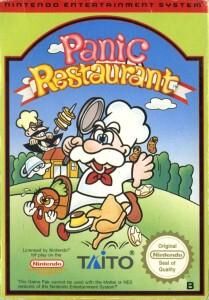
Panic Restaurant is a side-scrolling platform game where you play the role of Chef Cookie. The rival Chef Ohdove has taken over his restaurant, and it's up to Cookie to reclaim it. It's a fairly simple platform game. You run and jump, and enemies are placed everywhere trying to stop you. The entire game, backgrounds, enemies, and bosses, has a food theme. As you make your way through the restaurant, you encounter things like sausages, microwaves, onions, and hamburgers. To help you, you always have a frying pan with which you can hit enemies, and you can also find other items like a spoon and plates that you can throw at enemies. The game contains 6 levels, each in a different location in the restaurant, such as the kitchen, freezer, and basement. At the end of each level is a boss. Between levels there is a bonus game where you try to win additional health and lives at a slot machine.
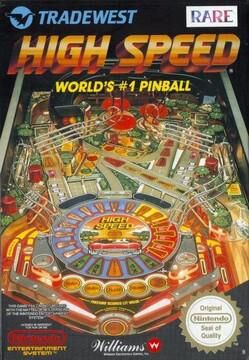
High Speed is an adaptation of the pinball machine of the same name by Williams Electronics. The game recreates the pinball table and gameplay of the arcade version and also adds some video game features, such as lightning bombs, attacking enemies, magnetic helicopters and rust balls that dissolve the flipper. The lower part of the screen remains on the lower flippers, whilst the upper half of the screen scrolls across the entire pinball table to follow the action. The game is for one to four players who take turns.
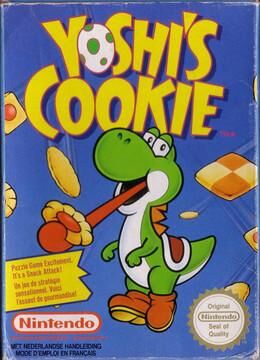
Yoshi's Cookie is a fast-paced puzzle game. The player shifts randomly placed cookies in rows and columns of cookies with similar patterns. When a row or column of matching cookies is successfully assembled, the row disappears and the player can start with a new row or column. The "Yoshi" cookie is something special in both the 1-player and 2-player games. Since this cookie is the key to both games, it should be used wisely. The SNES version features an additional puzzle mode where players must clear the game board in a limited number of moves. This mode contains 100 unique puzzles.
Elite is a freely designed space trading and combat simulation, widely regarded as the precursor to this subgenre. The player initially controls a character named "Commander Jameson", who starts at Lave Station with 100 Credits and a lightly armed trading ship named Cobra Mark III. The majority of the game involves travelling to various star systems, trading with their inhabitants, and earning money and reputation. Beyond trading, the player can earn money in other ways, such as through military missions, bounty hunting, asteroid mining, and even piracy. As the player earns money, they can upgrade their ships with better weapons, shields, larger cargo capacity, an automatic docking system, and more. The game uses pseudo-3D wireframe graphics; the world is viewed from a first-person perspective. It has no overarching story, although a race known as the Thargoids plays the role of antagonists: their ships often attack the player-controlled ship and force the player to engage in space combat. Combat is action-oriented and takes place in the same environment as exploration. The player must deploy various weapons with which their ship is equipped and manoeuvre the ship to evade enemy attacks. The player can also attack neutral ships, which damages the protagonist's reputation and eventually draws the attention of the galactic police. Elite stands out for its vast game world, which consists of eight galaxies and 256 planets. The player is free to travel to any of these planets, provided their ship has enough fuel for the journey (the ship's fuel capacity is limited to a journey of up to seven light-years).
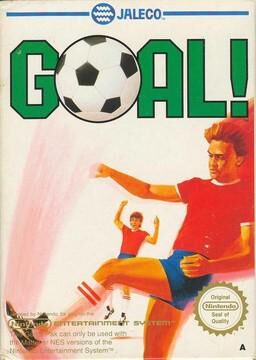
Goal! is a football game for one player against the computer, two players against each other or two players against the computer. Played from an angled top-down perspective, with the screen scrolling to follow the action. Several game options are available, including a tournament mode, a world championship mode and a goal-scoring competition.
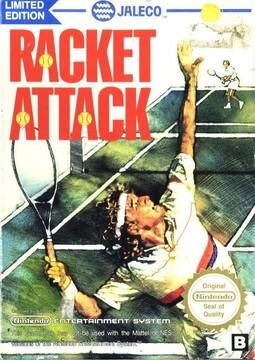
In Racket Attack, you choose between two different game modes. In single-player tennis, you are thrown into the middle of a national tennis tournament. Win seven increasingly difficult matches and take the championship trophy home. In two-player tennis, you face off on the opposite side of the net and compete in a head-to-head singles match. Once you've decided on a game mode, you can choose between men's and women's tennis and select from eight players in each category. Each of the eight different male and female players has different strengths and weaknesses. Once you've selected a player, it's time to choose the court surface. The game offers hard, clay, and grass courts. Then it's time to serve. Play follows normal tennis rules. Win your match by winning two out of three sets.